
What Should You Bring to the Hospital for Knee Replacement Surgery?

Packing for knee replacement surgery sounds simple—until you're actually standing in front of an empty bag wondering what you'll need.
Do you need several changes of clothes? Should you bring your walker? What will the hospital already have? And what are you actually going to need when it's time to go home?
The good news is that you probably don't need to pack nearly as much as you think.
Hospital stays after knee replacement are often relatively short, and some patients may even go home the same day. The goal isn't to prepare for every possible situation. It's to bring what you need to make your hospital experience and transition home a little easier.
Here are some things to think about before you start packing.
How Much Should You Pack for Knee Replacement Surgery?
Probably less than you're tempted to.
It's easy to approach surgery like you're packing for a trip, but the hospital isn't a hotel. Many of the things needed for your immediate medical care will be provided there.
Your length of stay can vary depending on your surgery, health, mobility, surgeon and hospital. Some knee replacement patients go home the same day, while others remain in the hospital longer.
That means your packing needs may be different from someone else's.
Instead of asking:
“What could I possibly need?”
A better question is:
“What will make the short time I'm there—and the transition home—easier?”
That mindset can help prevent unnecessary overpacking.
What Should You Wear Home After Knee Replacement?
This deserves more thought than what you'll wear to the hospital.
When it's time to leave, your knee may be swollen, movement may feel awkward, and getting dressed won't necessarily be as easy as it was before surgery.
Think comfortable, easy to put on, and accommodating of postoperative swelling.
You may also be using a walker or other assistive device, so what you wear—particularly on your feet—shouldn't make mobility unnecessarily difficult.
You don't need an entire postoperative wardrobe in your hospital bag.
You just need to think ahead about what getting dressed and moving around will realistically feel like after surgery.
Related: What to Expect the First 72 Hours After Knee Replacement →
Related: How Long Does Swelling Last After Knee Replacement? →
Will the Hospital Provide What You Need?
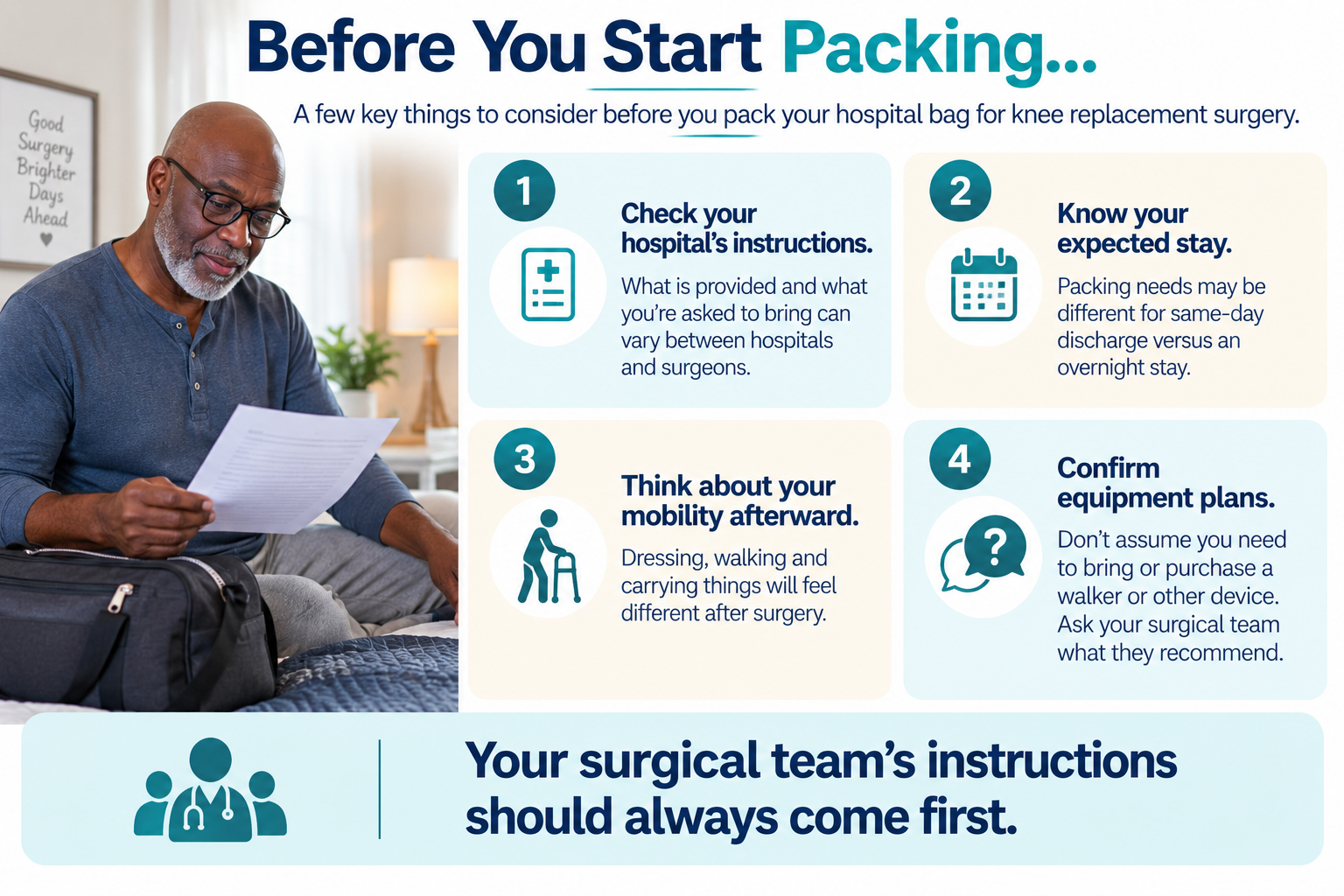
Hospitals generally provide the medical supplies and basic items necessary for your immediate postoperative care, but exactly what's provided varies.
This is one reason your own surgical team's instructions should always come first.
Before surgery, you may receive information from the hospital or surgeon explaining what they want you to bring, what they'll provide, and whether there are specific items you should leave at home.
Read those instructions before building your packing list.
It can save you from bringing things you won't use—or overlooking something your particular facility expects you to have.
Should You Bring Your Walker to the Hospital?
This is a great question to ask your surgical team before surgery rather than assuming either way.
Some patients already have an appropriate walker at home. Others may have equipment arranged through the hospital or another provider.
The process varies between facilities.
If you already own a mobility device, confirm whether your team wants you to bring it with you. Your physical therapy or hospital team may also need to make sure the device is appropriate for you and adjusted correctly.
Don't purchase or bring equipment simply because another knee replacement patient told you they needed it.
Your hospital's process is what matters.
What Personal Items Are Actually Worth Bringing?
This is where packing can get out of control quickly.
Rather than trying to anticipate every possible comfort or convenience, think about the small number of personal things that would be difficult to go without during your particular stay.
Consider your normal daily needs, your expected length of stay, and anything specifically requested by your healthcare team.
The important distinction is between:
“I routinely need this.”
and:
“Maybe I'll want this.”
Those two categories can produce very different-sized hospital bags.
Should You Bring Your Medications to the Hospital?
Don't assume you should simply pack your normal medications and take them as usual.
Your surgical team should give you instructions about which medications to continue, stop, or modify around surgery. The hospital may also have specific instructions about whether medications should physically be brought with you.
Follow those instructions carefully.
It's also important that your healthcare team has an accurate understanding of the medications and supplements you normally take.
If you're unsure what information they need or whether you should bring the actual medication containers, ask before surgery.
What Should You Leave at Home?
One of the easiest hospital-packing mistakes is simply bringing too much.
Remember that you'll be recovering from surgery—not managing luggage.
Anything you bring eventually has to be organized, kept track of, and taken home again.
Expensive or unnecessary valuables are generally better left somewhere safe, and items you're unlikely to use don't need to come along just because they might be useful.
A smaller, intentional bag is usually more practical than packing for every possibility.
Don't Forget About the Trip Home
This is the part of hospital packing that I think deserves more attention.
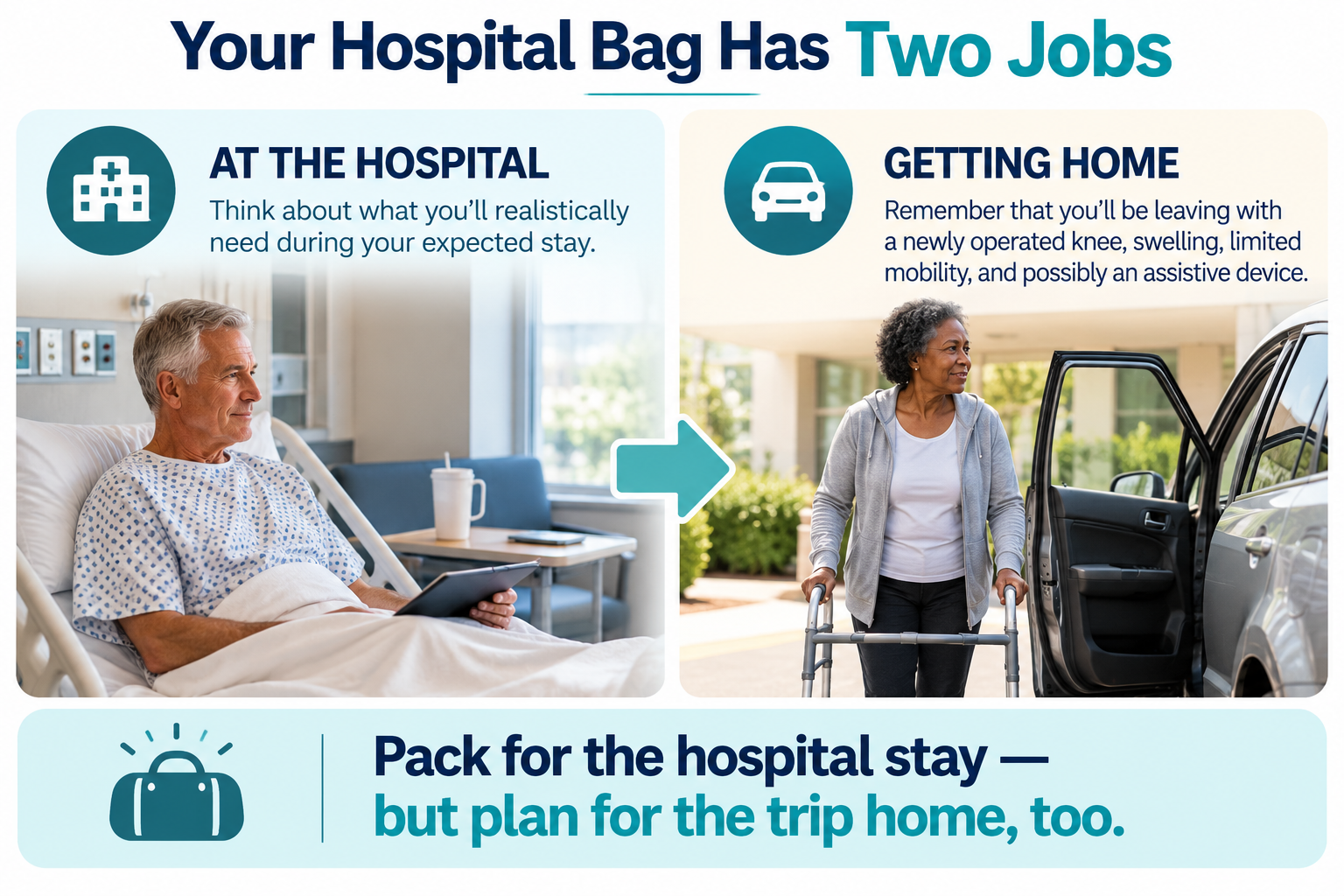
Your bag isn't only about what you'll use while you're in the hospital.
Eventually, you'll need to:
get dressed → leave your hospital room → get into a vehicle → ride home → get out of the vehicle → make your way into the house.
And you'll be doing all of that with a newly operated knee.
That means your preparation should account for the transition home, not just your time in a hospital bed.
You don't need to solve every detail while packing your bag, but thinking through that sequence ahead of time can prevent some unnecessary surprises on discharge day.
Related: How Should You Prepare for the Ride Home After Knee Replacement? →
When Should You Pack Your Hospital Bag?
Don't leave it until the night before surgery.
The days immediately before knee replacement can already involve appointments, instructions, medications, home preparation, transportation arrangements, and plenty of things to remember.
Packing ahead of time gives you an opportunity to check your hospital's instructions and identify questions while there's still time to get answers.
Once it's ready, it's simply one less thing competing for your attention before surgery.
You Don't Need to Pack Everything—You Need to Pack the Right Things
Preparing a hospital bag isn't about filling a suitcase.
It's about thinking ahead.
Your hospital stay may be shorter than you expect. Your mobility will be different after surgery. Some things will be provided for you, while others depend on your particular hospital and surgical team.
A little preparation beforehand can make surgery day and discharge feel considerably less chaotic.
But knowing the general principles and actually remembering everything you personally need to pack are two different things.
Your hospital bag is only one part of preparing ahead. Planning meals before surgery can also make the first days at home easier. Learn what to eat after knee replacement surgery →
Want a Knee Replacement Packing List You Can Actually Check Off?
You have enough to remember before surgery without trying to build your own packing checklist from scratch.
The Post Op Ready Knee Replacement Hospital Packing List organizes the practical items to consider before you leave for the hospital, giving you a simple checklist you can work through ahead of surgery.
Explore the Knee Replacement Hospital Packing List →
Preparing for More Than Just the Hospital?
Your hospital stay is only the beginning. The Post Op Ready Knee Replacement Bundle provides practical education and tools to help you prepare for the different parts of recovery at home.
Explore the Knee Replacement Bundle →
Not Ready for the Full Guide?
Start with our free Knee Replacement Checklist for a simple introduction to preparing for surgery and recovery.
