
How Long Does Stiffness Last After Knee Replacement?

Stiffness is one of the most common—and frustrating—parts of knee replacement recovery.
Your knee may feel tight when you first get out of bed, stiff after sitting for a while, or harder to bend after you've been particularly active. Some days it may move surprisingly well, while on others it feels like you've taken a step backward.
For most patients, stiffness is most noticeable during the early weeks after knee replacement and gradually improves as swelling decreases, movement improves, and the knee continues to heal. However, some degree of tightness or intermittent stiffness can continue for several months.
Understanding why stiffness happens—and what changes are worth discussing with your healthcare team—can make these fluctuations much less confusing.
Why Does Your Knee Feel So Stiff After Knee Replacement?
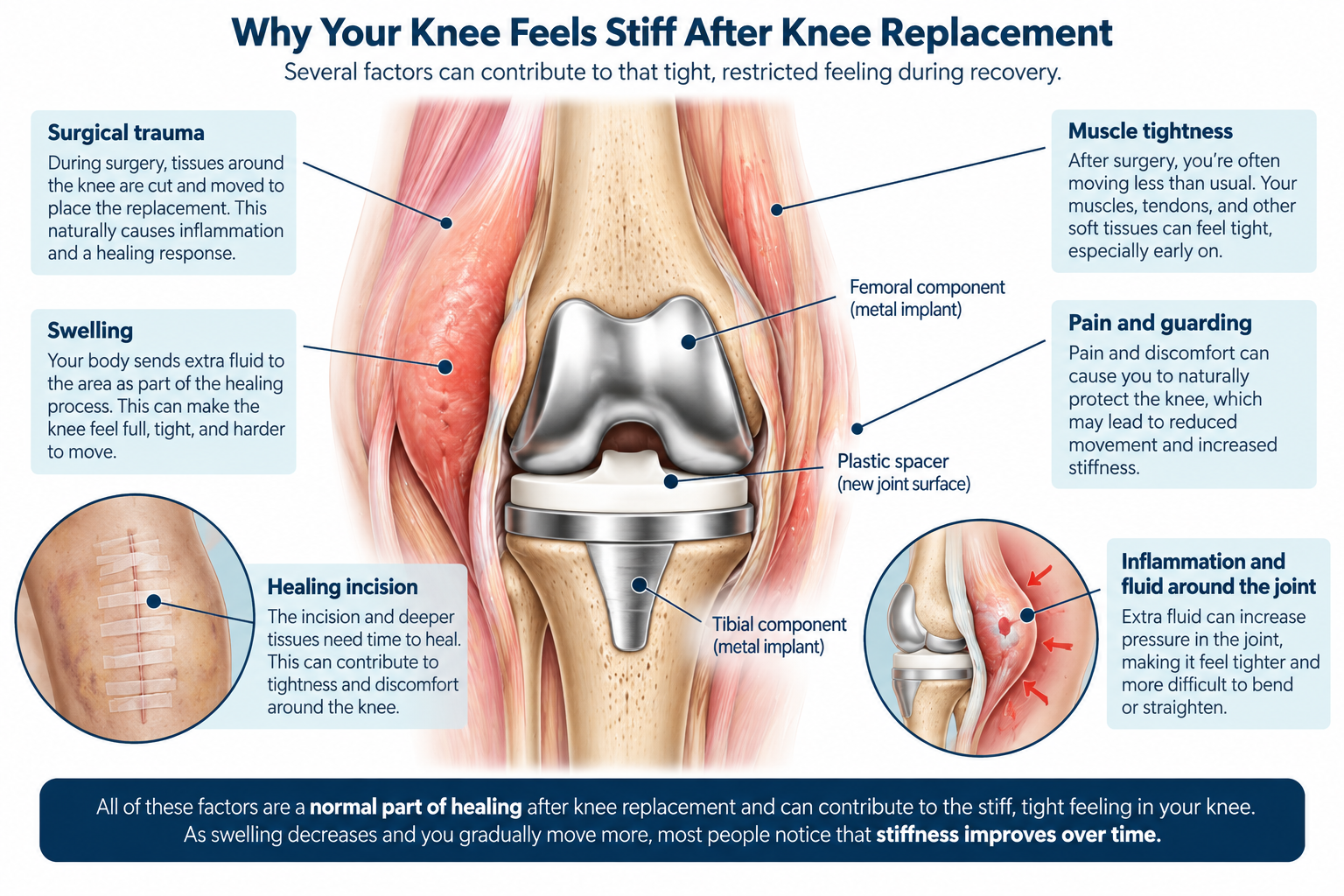
A knee replacement is a major operation, and stiffness is a natural consequence of what your knee has just been through.
During surgery, tissues around the knee are disrupted as your surgeon accesses the joint, prepares the bone surfaces, and positions the knee replacement components. Your body responds with inflammation and swelling as healing begins.
That swelling alone can make the knee feel surprisingly tight.
Pain and soreness can also make you move differently or guard the knee, particularly during the early stages of recovery. At the same time, you're typically moving much less than you did before surgery.
Put all of that together, and it's easy to understand why a newly replaced knee doesn't immediately feel loose and natural.
Related: How Long Does Swelling Last After Knee Replacement? →
How Long Does Stiffness Last After Knee Replacement?
There isn't one exact timeline that applies to everyone.
During the first few weeks, stiffness can be a very noticeable part of daily life. The knee may feel tight when you wake up, after you've been sitting, and at different points throughout the day.
Over the following weeks, most patients begin noticing that movement becomes easier and the knee doesn't feel quite as persistently tight.
By around 6 to 12 weeks, many patients have made substantial progress compared with those difficult early weeks. That doesn't necessarily mean the knee feels completely normal or that stiffness has disappeared.
Recovery continues beyond this point.
Some patients notice intermittent tightness or stiffness for several months, particularly after increased activity or periods of inactivity.
Rather than expecting stiffness to disappear on one particular date, look at the overall trend. Over time, the knee should generally feel less restrictive and everyday movement should become easier.
Related: What’s Normal After Knee Replacement? Common Symptoms & Warning Signs →
Why Is My Knee So Stiff in the Morning?
Morning stiffness after knee replacement is extremely common.
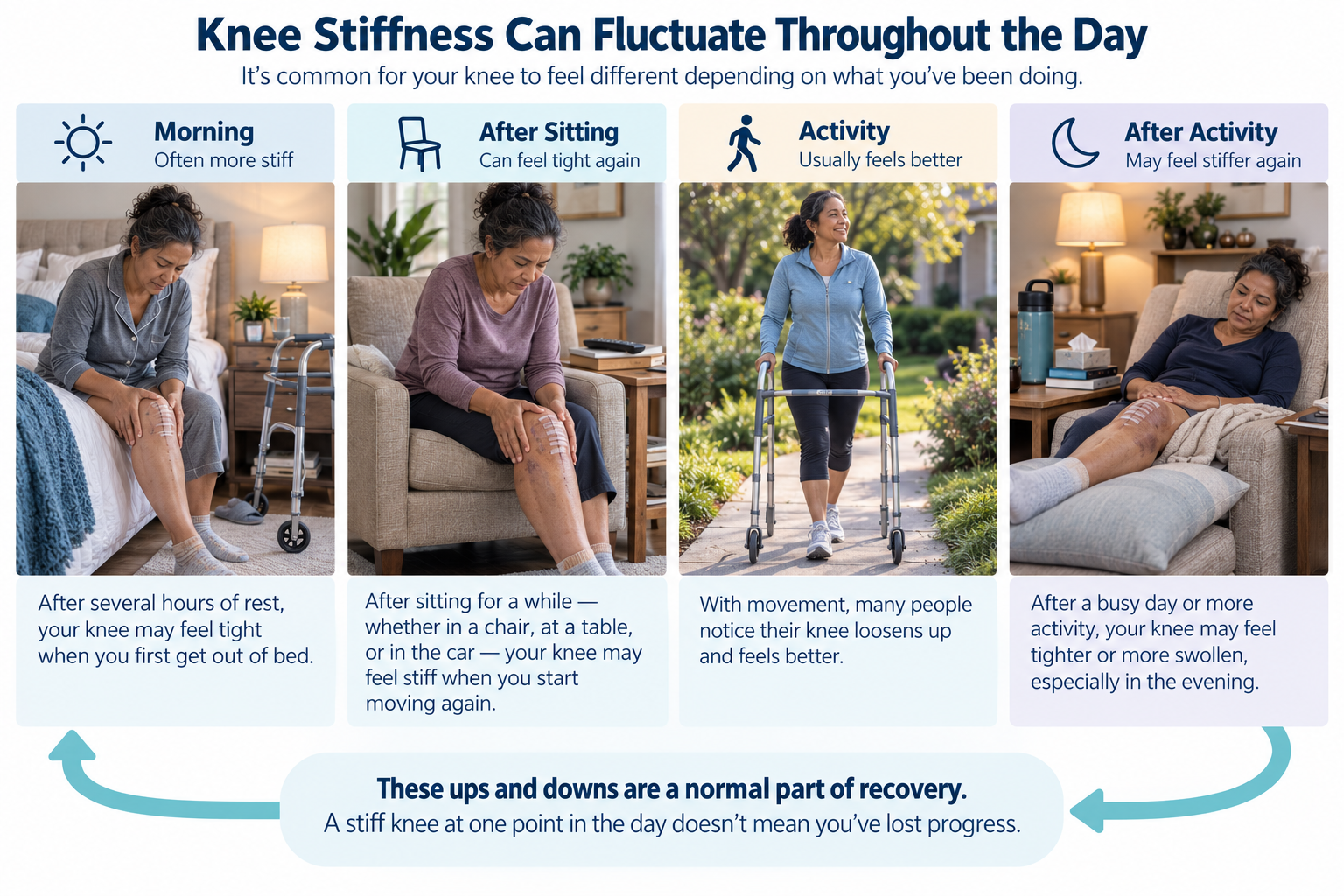
You've just spent several hours relatively still while sleeping. During that time, you haven't been regularly moving the knee through its available range of motion, and residual postoperative swelling may still be present.
As a result, those first few movements after waking can feel particularly tight or uncomfortable.
You may notice that the knee begins to feel better once you're up and moving around.
That doesn't necessarily mean something happened to your knee overnight. A knee that feels stiff when you first wake up but gradually loosens with normal movement can be a common part of recovery.
Why Does My Knee Get Stiff After Sitting?
The same general principle applies when you've been sitting for a while.
After spending time in a recliner, sitting through a meal, riding in a car, or watching television, those first few steps can feel surprisingly stiff.
Patients sometimes describe needing a moment to “get going again.”
A recovering knee often doesn't tolerate prolonged inactivity the same way it eventually will. Staying in one position for an extended period can make the knee temporarily feel tighter when you begin moving again.
As recovery progresses, this usually becomes less noticeable.
Related: Is Ice or Heat Better After Knee Replacement? →
Why Does My Knee Feel Stiffer After Activity?
This one can seem contradictory.
If movement is an important part of recovery, why does the knee sometimes feel stiffer after you've been active?
One common reason is swelling.
Walking farther, spending more time on your feet, completing rehabilitation, returning to work, or simply having a busy day can temporarily increase swelling around a healing knee.
More swelling can create a greater sensation of pressure and tightness around the joint.
This is why you may have a morning when the knee feels relatively good, become much more active during the day, and then notice that the knee feels tighter that evening.
That fluctuation doesn't automatically mean you've damaged the knee or lost your progress.
Can Swelling Make Knee Replacement Stiffness Worse?
Yes. Swelling and stiffness are closely connected after knee replacement.
Extra fluid around the knee can make the joint feel fuller and tighter and may temporarily make bending or straightening feel more difficult.
That's also why stiffness can change from one day—or even one part of the day—to another.
As postoperative swelling gradually decreases, many patients notice that the knee feels less persistently tight as well.
If you'd like to understand the typical swelling timeline in more detail, read:
How Long Does Swelling Last After Knee Replacement? →
What Can Help With Stiffness After Knee Replacement?
Some stiffness is expected, particularly early in recovery. The goal isn't necessarily to make the knee feel completely loose immediately after surgery.
Your surgeon and physical therapist may recommend strategies that include regular movement, following your rehabilitation plan, managing postoperative swelling, avoiding excessive periods of inactivity, and gradually increasing activity as your knee recovers.
Your specific rehabilitation plan—including exercises, range-of-motion goals, activity progression, and precautions—should come from your surgeon and physical therapist.
One important thing to remember is that recovery can fluctuate.
A stiff afternoon doesn't necessarily erase the progress you made earlier in the week.
When Should I Be Concerned About Stiffness After Knee Replacement?
Some stiffness is expected. However, there is a difference between a knee that feels temporarily tight and a knee that is persistently struggling to regain motion.
Contact your surgeon or physical therapist if you're concerned about your progress, particularly if:
Your knee motion isn't progressing as expected
You begin losing motion you previously had
Stiffness suddenly becomes significantly worse
Increasing stiffness occurs along with worsening pain, redness, warmth, drainage, fever, or significant swelling
Stiffness is increasingly interfering with your ability to walk or complete everyday activities
Your healthcare team has given you specific range-of-motion goals that you're struggling to reach
A small percentage of patients develop significant postoperative stiffness that may require additional evaluation or treatment.
That's one reason it's important to stay in communication with your surgeon and physical therapist about your range-of-motion progress, rather than simply waiting for severe stiffness to resolve on its own.
Is It Normal to Still Feel Stiff at 3 or 6 Months?
It can be.
By three months, many patients are functioning considerably better than they were during the first few weeks after surgery, but that doesn't mean the knee necessarily feels completely normal.
You may still notice tightness after sitting for a long time, first thing in the morning, or after a particularly active day.
Even at six months, some patients occasionally notice stiffness or a sense that the replaced knee still feels different from the other side.
Knee replacement recovery continues for months, and the way the knee feels can continue changing even after you've returned to many of your normal activities.
What's generally more important than whether you experience any stiffness is the direction your recovery is moving.
Over time, you'd expect the knee to become less persistently restrictive and more capable of handling everyday life.
Knee Replacement Recovery Is More Than a Timeline
Knowing that stiffness can be normal doesn't always make recovery easy.
Once you're home, questions often start piling up:
Is this amount of swelling normal? Why am I still having trouble sleeping? Am I doing too much—or not enough? When will everyday activities start feeling easier? Is my recovery actually on track?
The Post Op Ready Knee Replacement Bundle was created to help patients and families better understand what to expect throughout knee replacement recovery—from swelling and sleep to everyday activities, caregiver support, common recovery concerns, and returning to life.
Instead of trying to piece together your recovery one question at a time, you'll have patient-friendly resources designed specifically for the knee replacement journey.
Explore the Knee Replacement Bundle →
Not ready for the full bundle?
Preparing for knee replacement? Download our free Knee Replacement Checklist for a simple starting point to help you prepare for surgery and recovery.
